Friday, 19 July 2013

The Silent Film


The next bit of this foolish endeavour to justify four years of top class education will focus on one of my favourite courses, Interwar Cinema, particularly on Silent Cinema. Interwar was brilliant, as it covered a lot of films that I never knew were my favourite until I watched them for the first time; The Scarlet Pimpernel, A Star is Born, Lost Horizon, Madame Bovary (that last one’s French, so you know it’s good and mental) but none were as good as the silent movies I indulged in.

Can I just take a moment to say how good silent films are? It’s like what that Norma Desmond said in Sunset Boulevard – “We didn’t need dialogue, we had faces!”


Norma was obviously the picture of reasoned argument

With a silent movie, you’re relying totally on the cinematic language to tell the story. Actors could remain an enigma, their characters barely ever even having names in the early years. They weren’t the star; the camera was, showing wonderful new things with new equipment every single day. Nickelodeons and later Picture Palaces sprang up across the globe, and new art movements were created in the blink of an eye, let alone techniques which are still used today (apparently, the montage existed before Rocky IV, which was astonishing news to me). Sunrise is one of the most life-affirming films I’ve ever seen, and that little gem starts with attempted wife murder.

Cinema really found its stride just before the 1920s, right when Thomas Edison was chasing all the early filmmakers out of New York and into Los Angeles, where the sun always shone and unions hadn’t been invented on the west coast yet, so everything was nice and cheap (if just a touch deadly). Come the 1920s, some smart people thought that what this new Hollywoodland real estate needed was a big old sign in flashing lights –


Yeah, this would do nicely

And films became less of a curious phase, and a full on glamour fest of epic proportions. The actors, once looked over like so many sultanas in a fruit salad, suddenly became the main attraction, as so many of them embodied that elusive American Dream. Rudolph Valentino for example was an Italian immigrant who came over to Hollywood in 1913, worked his way through small parts until Paramount bought his soul (contracts were harsher back in the day) and modelled him as a Great Lover in the amazingly bonkers The Sheik.

                                                 
This guy.

Oooh, The Sheik is fun. It’s about an English Rose who gets kidnapped by Arabs, only to fall in love with their leader Valentino, who boggles his eyes seductively throughout the film and turns out to be quite nice really, underneath all of his foreignness. Valentino epitomised all that was enticing about the new Hollywood system; if you worked hard and looked the part, you too could live in a fabulous mansion and be adored by millions. So what if you died young (like Valentino), had your marriage destroyed (like Mary Pickford) or flamed out so spectacularly your fall from grace is still whispered in rehab clinics across the world (like Clara Bow)? For one moment, you could be the star of a studio, you could be immortalised in lights forever.

Which is why it’s strange that so many films about Hollywood seem to really hate Hollywood. Take, if you would be so kind, The Extra Girl. Sue Graham (Mabel Normand) dreams of becoming an actress and escaping an unwanted marriage, but when she arrives in Hollywood from Pittsburgh (she was the original small town girl living in a lonely world), it turns out her picture, with which she won a competition to get a part in a movie, was switched with another woman’s photo. Her dreams of acting languish as her parents follow her to Hollywood, where they’re promptly robbed blind and Sue nearly shoots a guy. So come to Hollywood, follow your dreams, but don’t think for a moment you can be like us, good Lord no.

If Hollywood was the stuff of dreams, then European silent films, especially German films, was fast becoming the artsy (and indeed fartsy) cinema of the world. Films like The Cabinet of Dr Caligari, Un Chien Andolou (which I’ve written at length about here) and Battleship Potemkin (which you are obliged to mention in every single film essay you write) were instant, weird classics, pushing the boundaries of technology, art and sometimes taste. It wasn’t all good stuff though; one of the absolute classics, the type that critics talk about in hushed tones, The Joyless Street, is a struggle and a half to get through. 

For a start its three hours long without a single joke; nary even a flicker of a smile can be raised to alleviate the constant oppression of the noble German. Each and every single female character becomes a prostitute at some point, all of the male characters are hatefully ignorant and no one has a happy ending, apart from a baby whose parents are killed by a fire which he somehow escapes. I know there’s a place for films like this, but the horrible tragedy is so overwhelming that it becomes a self parody by the time the third lady heads to the local brothel to feed her elderly father.

However, the march of technology meant that despite many people’s misgivings, the talking picture sensation, which first came to screens in 1927 and was a cultural behemoth by 1929, put a nail in silent cinema’s mainstream appeal forever. Looking around, silent cinema seems to be restricted to short animations (the gloriously delightful Paperman being a prime example) and experimental affairs, like Silent Movie and The Artist, the former a homage to Buster Keaton and Harold Lloyd style slapstick, the latter a homage to really, really good films, told in the way which best suits their stories, sound, colour and 3D be damned.
 
And since this is my blog and my rules, I can end how I like, so here are some production stills of the King of silent Hollywood, Douglas Fairbanks, who out-Errol Flynned Errol Flynn before out-Errol Flynning Errol Flynn was even a thing.

                                                                          
Now he did have a face...

Monday, 1 July 2013

A Moment of Innocence


A Moment of Innocence, M2K Productions, 1996, directed by Mohsen Makhmalbaf. Starring Mohsen Makhmalbaf, Mirhadi Tayebi, Ali Bakhsi.


As you probably gathered, I graduated with a 2:1 MA in Film and TV Studies last week from Glasgow (pause for applause). Apart from the mountains of debt, amazing people I met and just general awesome experience of doing an arts degree in a place like Glasgow, I picked up a few decent films over the four years of studying them, and I’m going to spend the next few posts talking about my favourite ones, starting with one from my Iranian Cinema course, A Moment of Innocence.  

Iranian Cinema has most in common with high European art film, and if you’ve stayed awake during that last sentence, you’ve done better than me. It’s a difficult world to go into, because although Iranian filmmakers are respected worldwide, censorship laws in Iran (which, simply put, are mental) means that exposure to Western cinema in Iran is severely limited, meaning Iranian cinema evolved into its own style. Another thing to keep in mind is that cinema is a huge deal in Iran; not movies, but proper grown up cinema which would listen to Italian opera and casually refer to Wittgenstein. Everyone in Iran knows who Mohsen Makhmalbaf is and his life story, bringing us round to A Moment of Innocence.

  It may not look it, but this shot will make you cry.
Like, sob for minutes in the most ungainly manner possible.

When he was seventeen, Makhmalbaf and his cousin stabbed a Shah policeman to steal his gun and rob a bank to help fund the revolution. He was released from prison by revolutionaries and became one of Iran’s most successful directors, when one day the policeman finds him, telling Makhmalbaf that the director owes him a job as an actor as payment for the stabbing. The story follows Makhmalbaf, the policeman and the two young actors who play them in the reconstruction of the stabbing as they discover more about each other, the recent history of Iran and what the future holds for the country.

But oooh, it’s so much more than that. Makhmalbaf actually stabbed a man, and the man actually came to see him years later for a job. This basis in reality means that you're constantly looking for truth in the narrative, where real events and people intertwine with fiction and filmmaking. Makhmalbaf plays himself, acting as a voice of God behind the camera and in front of it, giving more weight to the documentary reconstruction interpretation of the film. But Makhmalbaf is not so clumsy as to use mere flashback and narrative constructs to depict the past, no no no. A gentle rush of wind is heard in the periphery and suddenly the young actor is no longer himself, but a seventeen year old Makhmalbaf plotting with his cousin to bring down the Shah, one policeman at a time. It’s an incredible moment, because just for those brief five minutes, it feels like you’re not watching film, but a piece of history.

It’s a complex film, with each scene deconstructing the previous one until it seems that the film falls under its own weight and snaps, the final scene played so intensely straight and for real it’s a chokingly powerful moment. The policeman’s gun is real, Makhmalbaf’s knife is real, the emotions and relationships between the characters are so real that though it’s supposed to be a reconstruction of the stabbing, when the films turns another way, it’s as though history has been rewritten.

This was Makhmalbaf’s intention all along. He has since moved away from his radical ideology and is now friends with the policeman, who is shown to be sympathetic, noble and most of all human. A Moment of Innocence takes an intensely violent period of Iran’s history, but rather than dwell on it and stir up the violent emotions again, the film shows the potential future of Iran as one of peace and friendship. It’s an important message, compounded all the more by the fact the film is still banned in Iran for being anti-revolutionary.

Bloody censorship, eh?

Sunday, 26 May 2013

Star Trek Into Darkness


Star Trek Into Darkness, Paramount Pictures, 2013, directed by JJ Abrams. Starring Chris Pine, Benedict Cumberbatch, Zackery Quinto, Zoe Saldana, Karl Urban, Simon Pegg, Alice Eve, John Cho, Anton Yelchin.
 

BOOM! YEAH! STAR TREK!

I was never actually a Trekkie myself, but a combination of my mum (an original 60’s Trekkie who, no lie, got stuck in a lift with Deforrest Kelly one time) and the constant barrage of Trek references scattered across the internet means that when Star Trek came out in 2009, I actually got the references to Red Shirts, the Prime Directive and what the hell was going on with the Romulans. What I didn’t get was how sexy and cool and fun Star Trek was. JJ Abrams went back to the days of old, before Trek became painfully niche and loved only by cellar dwelling mouth breathers, back to a time when Kirk and Spock were young and sexy. Star Trek made Trekking fun again, taking it back to the mainstream where it sits very comfortably. Which is a good thing, because I doubt there’ll be a better blockbuster out this year – Into Darkness is goofy, fun and loud; oh it’s flawed (quite troublingly so in one aspect) but I defy you to have a better time at the cinema this year.

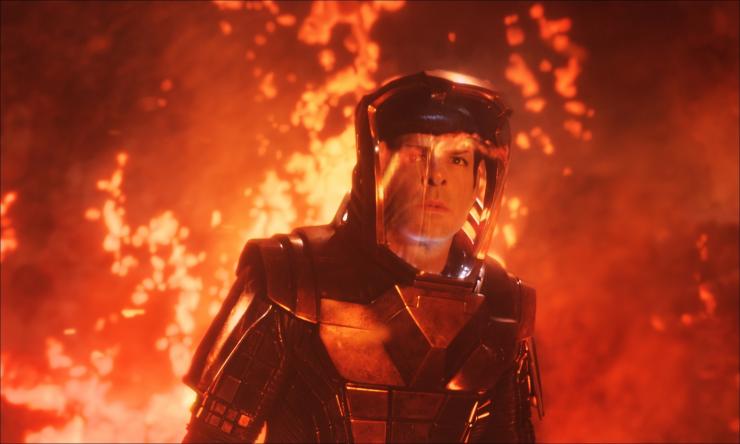
Any film that starts with a discussion of Bentham Utilitarianism inside an exploding volcano is obviously going to be all of the fun, and it doesn’t really let up from there. The characters discuss terrorism, conspiracy, freedom fighters and the politics of war, but they never do so without at least three explosions in the background. 


Spock, in a volcano, enjoying a quiet character moment

That’s not to say that the plot doesn’t matter at all - in fact it’s rather good. After a bomb in London kills forty three Starfleet agents, Admiral Marcus enlists Captain Kirk  and The Enterprise to go to the edge of the known universe and destroy the man responsible, rouge agent John Harrison. It becomes Star Trek Into Zero Darkness Thirty, the themes of justice and retribution running throughout the film. Kirk wants to murder Harrison in cold blood, Spock  wants to capture him and put him on trial, Scotty  doesn’t like the weapons of mass destruction Marcus insist they use, Uhura  has to fight for a chance to use diplomacy. However, the juxtaposition of the serious acts of terrorism with the silliness of the lens flares works. The bombastic cinematography means the film never becomes preachy or starts to take itself too seriously. Where The Dark Knight Rises suffocated on its own pretentiousness, it’s never a problem with Into Darkness, evidenced by a very tense scene alleviated by the simple (and very funny) act of Scotty running hell for leather down a massive hanger.

The cast is uniformly excellent, carrying their roles with grace and confidence. Chris Pine is a less confident Kirk this time around, feeling his way around the Captain’s chair after two serious arguments knock his self-assurance and he finds a sense of humility and grace in leadership. Zoe Saldana and Zackery Quinto, astonishingly, make Uhura and Spock’s relationship believable and tender, Simon Pegg’s Scotty becomes an action man and just he about pulls it off. Newcomer Alice Eve as Carol Marcus holds herself with dignity, despite a very gratuitous scene where she gets half naked for next to no reason. Abrams said it was to balance out Kirk’s nude scene, which occurred earlier in the film, but I call BS on that. See, Kirk was half naked, but so were the sexy alien ladies he was with – Kirk was obviously in a position of power and the Male Gaze went unquestioned. Carol, on the other hand, was ogled against her will. Kirk was asserting his authority and his position of power over her; I’m pretty sure that’s sexual harassment, and it’s a sticking point in the film.

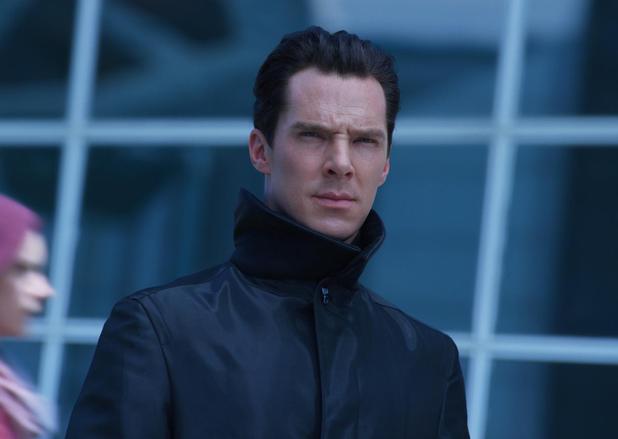
However, it thankfully only remains a small sticking point because the Glower of London, formally known as John Harrison, formally known as Benedict Cumberbatch, is too good for something as slight as casual sexism to stop you from having a good time. Cumberbatch is breath-takingly good as a man who would murder forty three people just to get Starfleet’s attention. It’s a testament to his talents as an actor that he remains morally ambiguous despite the music introducing him with a score which, if were any more obvious, would be entitled Hey Look! The Bad Guy’s Here! One thing about 2009 Star Trek was that Eric Bana’s Nero wasn’t that compelling a villain; it is safe to say that this is no longer a problem.

 Seriously though, if he smouldered anymore he’d be on fire

Star Trek Into Darkness is the most fun I’ve had in a cinema in a long time. It strikes a fine balance between the silly and serious, the loud and quiet and is even quite moving in places. I laughed, I gasped, I cried, I even clapped with glee at certain moments - it's just such a shame that one throw away gag demeaned Carol Marcus's entire character. Abrams listened when his villain was weak, hopefully he'll take on board the very valid criticisms about sexism in his films and make good with Star Wars. Ball's in your court, JJ. Don't make the same mistake again.

Tuesday, 7 May 2013

Porn, the Friendzone and Icky Language


So let’s talk about porn. Specifically, its impact on everyday life and the repercussions it has on the world outside of the internet.  Even more specifically, the language people use when describing others, and what that says about them and their expectations of sex after it’s been warped by porn, starting with language.

The reason why I decided to write about this subject was because of a conversation I overheard outside of my library. Two men were swapping stories, when I heard one say this:

‘That bird was a cumslut’.

That’s all. They laughed and carried on talking, oblivious to my impotent rage as I wondered if I could punch them both for been horrible people and having their odious conversation within my earshot. Anger turned to bewildered curiosity as to how this word has come to be. Who even talks like that anyway?

Well, the internet, for one. A search for ‘cumslut’ will result in over three and a half million hits, including a Twitter hashtag, various blogs and Tumblr accounts and endless, endless porn links. Urban Dictionary has the term defined as ‘any loose woman or slut’, a ‘husband’s whore’ and (oh, how this one is my favourite) ‘any little whore that likes dick in her mouth’. It seems that any woman who enjoys giving head is automatically a ‘cumslut’; it’s the virgin-whore dichotomy, that wonderful phrase which quite depressingly seems to summarise the objectification of women. If you haven’t heard of it before, it basically means (in this context anyway) that any woman who enjoys sex, enjoys her partner’s enjoyment of sex and is risqué enough to give a blow job is obviously a filthy whore. However, if she doesn’t want to have sex or touch your junk, then she’s a frigid bitch, who’s probably sleeping around with everyone else anyway.

I think that this means that terminology like ‘cumslut’ is used to control the idea of a woman who likes sex; keep the freaky stuff freaky, but for God’s sake don’t act like you’re enjoying it for yourself because then the man isn’t in complete control. So words are invented to make her enjoyment seem unnatural and weird, and that’s one thing on the internet but in reality? Real life where real people overhear you use words like this? It’s horrible. I would think of something pithy to slam down this word, but in all honesty I’m just sort of depressed by it.

Women are usually controlled in some sense in porn. The classic pizza boy routine shows this: ‘Oh I can’t pay the seven quid I owe you for this pizza with extra sausage, so please – do with me what you will’. By not having the cash on her (which seems like poor financial planning) the woman gives her body as a bartering tool; it’s like the Babylonian slave market, but with terrible lighting. Women are used, abused and handed around like tools, reduced to masturbation aides and then thrown aside; so why not call her a cumslut? That’s all she is and all she’ll ever amount to being.

But this is porn, not real life. Any man who works for Dominoes expecting more than a thank you at the door will be nastily surprised, and probably fired for creeping on the female customers. Adults (please let this be true) know that porn is stupid and is not how people interact in reality, but then again, it’s still obviously a problem that women are expected to behave in a certain way or, by God, there will be consequences. A non-porn example would be the viciously misogynistic ‘friendzone’. The thought process could only go like this when it comes to the friendzone: “What? Be ‘just friends’ with a woman? Give her emotional support and companionship without expecting sex as a reward? Good heavens, what an idea! She must be sleeping with everyone else but me, the whore!”

Don’t believe me? Read ‘Ode to the Nice Guy’ and tell me that the writer doesn’t come off like a whiny weirdo. This piece was everywhere a few years ago, and all you need to do is look on Reddit, Roflzone or 9gag for the remnants of it today: 


It’s funny, because she doesn’t want to sleep with you so you are within your rights to immolate her! HAHAHAHA. HAHAHAHA. HA.

So what does this have to do with ‘cumslut’? Hearing the word in reality means something important; it means what is acceptable (in the most sarcastic of air-quotes you can imagine) on the internet is now acceptable in real life – the concept of a friendzone is now a real thing which real people complain about. Women are polarised as being two different things – a frigid tramp. This is not cool, because it removes any possibility of seeing the women in your life as anything more than potential masturbation tools.

It’s harsh, and I must say that the men I know and am friends with are all very much normal people. In fact, almost all of the men I’ve met are cool, funny and will probably agree that friendzoning is creepy and ‘cumslut’ is not how you should talk about anyone. But if ‘cumslut’ becomes common vernacular, on and offline, I feel that the gender gap will widen even more, vilifying men and debasing women. Which is sad, particularly for delusional pizza boys.

Wednesday, 1 May 2013

Love is all you Need?


Love is all you Need?, Wingspan Pictures, 2013, directed by Kim Rocco Shields. Starring Lexi DiBenedetto, Kellan Lutz, Camilla Belle, Abbie Dunn.


I, like the majority of the population, am straight. I like men and their manliness and I’m fascinated by how straight women indulge in billions every year on books and magazines for how to get a straight man to like you, as if sex and procreation is a relatively new thing we’re still figuring out. I don’t really care whether you are straight or not; you are who you are, and I like to think that the Western world is now somewhere that this sentiment is shared by the majority of people. So it’s interesting to watch this short film by Kim Rocco Shields where straight people are the minority in a homosexual society. 

In this is a world, heterosexuality is a filthy sin. There are some really nice touches, such as the ‘Marriage is Equal’ sign with two male stick figures and the heterophobic Bible verses in the opening credits – this is a world which ought to be similar, but with these roles switched. This is simple enough, but it is a compelling way to make straight people think for twenty minutes about what life could be like if we weren’t so assuredly in the majority.

We follow young Ashley, an 11 year old girl who likes boys, much to the horror of her teachers and the disgust of her classmates. She’s alienated and bullied mercilessly until she decides to take her own life rather than admit to her parents that she’s heterosexual. This is sad, and what’s made even worse is that all of the abuse Ashley receives is based on actual accounts of homosexual kids in America. So the name-calling, hitting, isolation and humiliation are an amalgamation of several children’s torment, and the idea that this would drive a child to suicide is both horribly sad and real. I don’t feel like I can comment on this angle of the film because I’ve never known bullying like this, nor can I understand the mindset of someone who thinks this is an acceptable way to treat other people. Ashley’s loneliness is heartbreaking and Lexi DiBenedetto is a naturally gifted actress.

However, I have serious issue with the treatment of religion in this film. There is a scene where Ashley’s family are in church and a female priest raving about how hetero’s who breed outside of the ‘season’ are hateful and will burn in hell. Now, I’m fully aware that there are some priests that do teach this about homosexuals, but guess what? They do not represent the majority of priests! Many, many priests see homosexuality as a natural state for some people to be born into and they teach that ‘Love is patient, love is kind. It does not envy, it does not boast, it is not proud’. A lot of Catholics don’t believe that same-sex marriage should be allowed; they do not however, hate homosexuals, because 'not hating people' is sort of integral to the Catholic message. My point is that the hysteria generated around the priest and religion is just nonsense. It’s the modern world with iPhones and Facebook, yet the hysterical priest belongs more in the Dark Ages. This reversed interpretation bears no relation to the experience of church today and is just pointlessly provocative.

Love is all you Need? is an interesting ‘What If’ film, of the same sort as Kevin Willmott's The Confederate States of America, but it rings hollow. the film doesn’t give itself enough time to flesh out the nuances of a homosexual society, like the idea of a ‘breeding season’ and a female Pope, but everything else seems like it’s just swapped hetero for homo and made everyone about ten times more homophobic than in reality. The thing about people is that we don’t irrationally hate just one minority for one reason; we irrationally hate a whole bunch of other people for a plethora of reasons! If the adults in the world were irrational about other things as well I might buy it, but because they aren't, I can’t. If you want to tell the story of a girl who is driven to suicide because of the loneliness, the hostility and the complete lack of understanding she faces day to day, why not do that? The gimmick of a hetero minority ends up just being that – a gimmick which stops a powerfully heartbreaking story from really developing. Ultimately, the film lacked complexity and, beyond DeBinedetto's performance, nuance.